










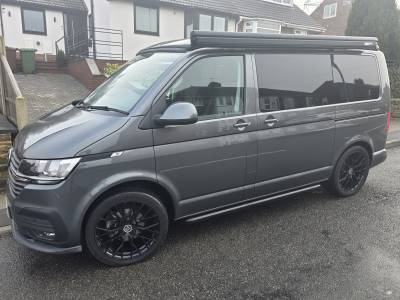
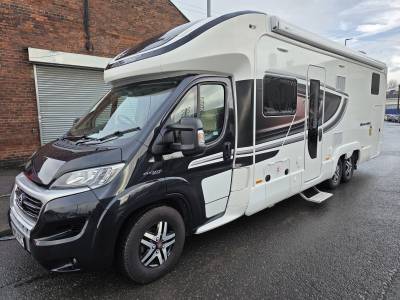
Motorhomes For Sale Near Me
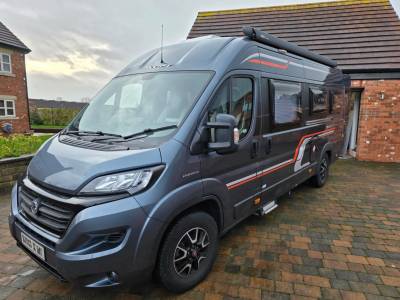
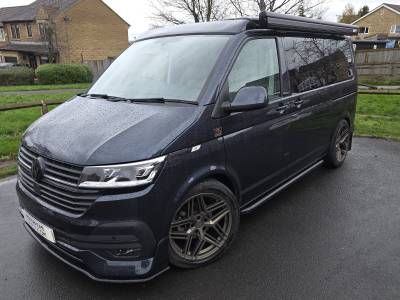
Looking to buy a motorhome in your local area? We are the local specialists and offer a wide range of motorhomes across a range of sizes and prices. We have motorhomes for sale in Wakefield. We offer campervans in Huddersfield and Dewsbury. Check out our range of motorhomes in Ossett.
Wakefield is a cathedral city[a] in West Yorkshire, England located on the River Calder. The city had a population of 109,766 in the 2021 census, up from 99,251 in the 2011 census.[1] The city is the administrative centre of the wider Metropolitan Borough of Wakefield, which had a 2024 population of 367,666, the 27th most populous district in England. It is part of the West Yorkshire Built-up Area and the Yorkshire and the Humber region.
In 1888, it gained city status due to its cathedral. The city has a town hall and is home to the county hall, which was the former administrative centre of the city's county borough and metropolitan borough as well as county town for the West Riding of Yorkshire.
The Battle of Wakefield took place in the Wars of the Roses, and the city was a Royalist stronghold in the Civil War. Wakefield became an important market town and centre for wool, exploiting its position on the navigable River Calder to become an inland port. In the 18th century, Wakefield traded in corn, coal and textiles.
Wakefield is 9 miles (14 km) south-east of Leeds and 28 miles (45 km) south-west of York on the eastern edge of the Pennines in the lower Calder Valley. The city centre is sited on a low hill on the north bank of the River Calder close to a crossing place where it is spanned by the 14th-century, nine-arched, stone Chantry Bridge and a reinforced concrete bridge built in 1929–1930.[66][67] It is at the junction of major north–south routes to Sheffield, Leeds and Doncaster and west–east routes to Huddersfield, Dewsbury and Pontefract.
Wakefield is within the area of the Nottinghamshire, Derbyshire & Yorkshire coalfield and lies on the middle coal measures and sandstones laid down in the Carboniferous period.[68]
Wakefield includes the former outlying villages of Alverthorpe, Thornes, Sandal, Portobello, Belle Vue, Agbrigg, Lupset, Kettlethorpe and Flanshaw. In the 2011 Census, Newton Hill, Outwood, Stanley and Wrenthorpe were counted as parts of Wakefield, having been classified separately in the 2001 Census.
Dewsbury is a market town in the Metropolitan Borough of Kirklees, West Yorkshire, England. It is sited on the River Calder and on an arm of the Calder and Hebble Navigation waterway. It lies to the west of Wakefield, east of Huddersfield and south of Leeds. Historically a part of the West Riding of Yorkshire, after undergoing a period of major growth in the 19th century as a mill town, Dewsbury went through a period of decline. It forms part of the Heavy Woollen District, of which it is the largest town. The population of the built-up area was 63,722 at the 2021 Census.
Dewsbury is situated between Leeds and Bradford 8 miles (13 km) to the north, Huddersfield a similar distance to the south west, and Wakefield 6 mi (10 km) east. Its proximity to these major urban centres, the M1 and M62 motorways and its position on the Huddersfield Line, served by the TransPennine Express, have contributed to its growth.
Dewsbury is part of the West Yorkshire Urban Area, although its natural boundaries are not well-defined, with built up areas of the town running into Batley, Heckmondwike and Ossett.[citation needed]
Geologically, the town is situated on rocks of the Carboniferous Period, consisting of coal measures and gritstones. Quaternary Period rock, glacial deposits and gravels exist in the Calder Valley. Coal, sandstone and gravel have been exploited commercially. Average rainfall is 100 cm per annum.[21] The town is dominated by hills, notably Earlsheaton, Dewsbury Moor, Staincliffe and Thornhill. The town centre is between 130 and 180 feet (40 and 55 metres) above sea level, rising to 360 ft (110 m) at Earlsheaton and Batley Carr, and 755 ft (230 m) at Grange Moor. The approach from Earlsheaton through the Wakefield Road cutting, constructed in 1830 [citation needed], is dramatic with the view of the town centre in the Calder Valley opening up.